Sunday, February 12, 2006

Friday, February 03, 2006
The Light Fantastic
There’s a fine review of the current exhibition of Dan Flavin’s work at the Hayward Gallery in London here on the Observer website, most inspiring – the show is surely a must-see if one has the opportunity to do so.
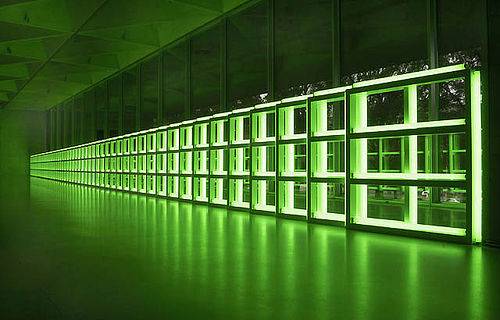
I recall seeing a smaller selection of Flavin’s fluorescent tube sculptures at the Serpentine Gallery in the summer of 2001, & one of the exhibits in particular, 'untitled (to you, Heiner, with admiration and affection)', a room-wide installation, was ravishing, with the green light of the tubes flooding the space & producing an amazing, stunning optical illusion in rendering the view outside through the room’s windows, of the grass & trees of Hyde Park outside, in shades of pink & violet, the natural world transformed into something apparently synthetic(ally coloured) – the fact of being able to explain such a phenomenon scientifically does nothing to diminish the magic of the aesthetic experience, of being there in the moment, amidst such a presence. Here’s an image of the work, alas without a complementary view outside & thus lacking that effect.

I recall seeing a smaller selection of Flavin’s fluorescent tube sculptures at the Serpentine Gallery in the summer of 2001, & one of the exhibits in particular, 'untitled (to you, Heiner, with admiration and affection)', a room-wide installation, was ravishing, with the green light of the tubes flooding the space & producing an amazing, stunning optical illusion in rendering the view outside through the room’s windows, of the grass & trees of Hyde Park outside, in shades of pink & violet, the natural world transformed into something apparently synthetic(ally coloured) – the fact of being able to explain such a phenomenon scientifically does nothing to diminish the magic of the aesthetic experience, of being there in the moment, amidst such a presence. Here’s an image of the work, alas without a complementary view outside & thus lacking that effect.
Thursday, February 02, 2006
Objets d’Art
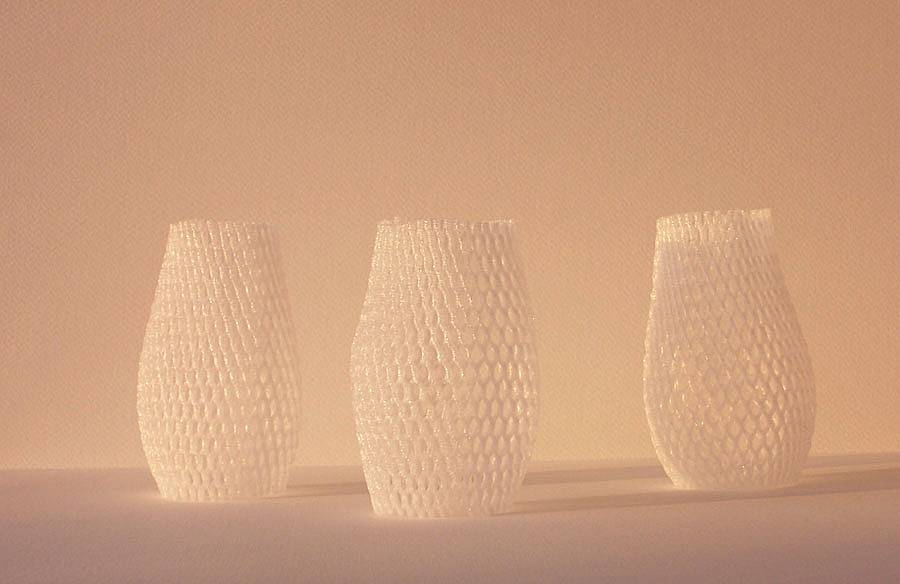
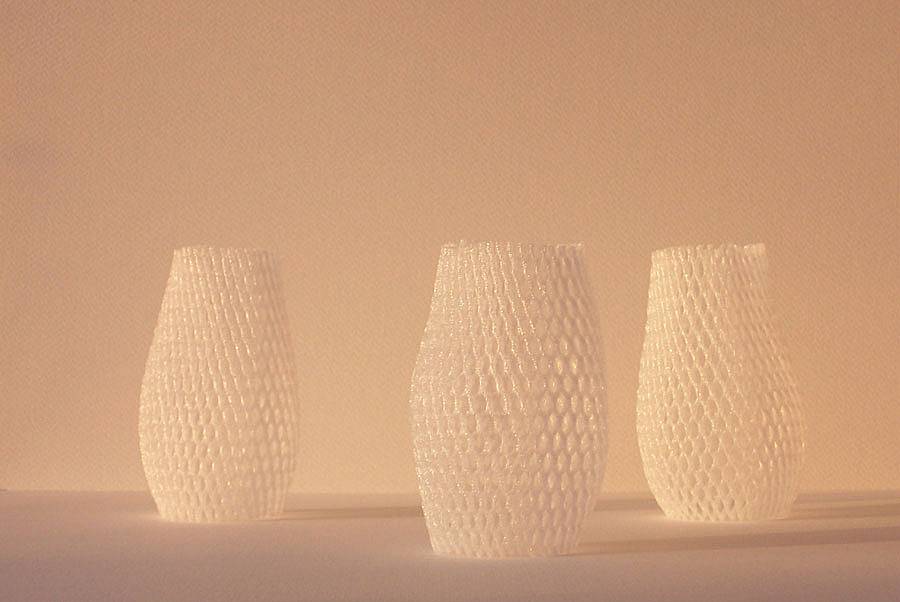
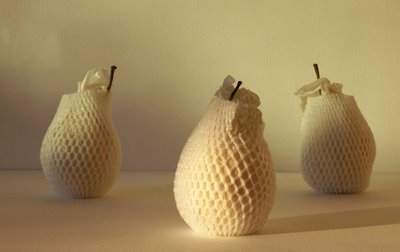
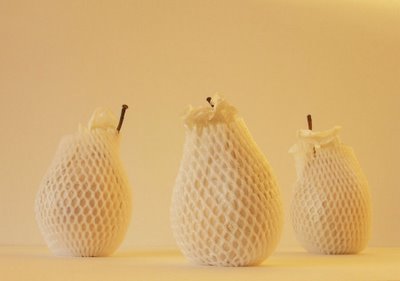
Freed from their functional purpose, I found the cocoons that had been protecting those Chinese pears as featured in recent posts to have, whilst retaining their visual interest as textured surfaces, something of another aesthetic quality altogether (indeed, liberated from their ‘usefulness’, the cocoons could be argued, if one should subscribe to a particular philosophy, to exist now as art, as purely aesthetic objects) & thus suitable further potential as photographic subject matter.
For all their apparent lacy, flimsy, transparent insubstantiality as actual, physically-experienced objects, still, within a photographic context at least, the cocoons retain a sense of form & physicality &, though their shape still echoes that of the pears formerly present within, because of the actual absence of the pears & the consequent ambiguity of scale of the cocoons, a certain structural, sculptural solidity if not, perhaps, the sheer presence & monumentality of the pears, covered or otherwise. Retaining a sense of the weight of the pears formerly contained within also seems to lend the cocoons a sense of substance.
With late afternoon sunlight raking in at a low angle, sharp, imposing shadows were produced & incorporated into some compositions as another element of the whole, in order to add a further dimension, to introduce some complementary dark tonal areas into the overall ‘lightness’.


For all their apparent lacy, flimsy, transparent insubstantiality as actual, physically-experienced objects, still, within a photographic context at least, the cocoons retain a sense of form & physicality &, though their shape still echoes that of the pears formerly present within, because of the actual absence of the pears & the consequent ambiguity of scale of the cocoons, a certain structural, sculptural solidity if not, perhaps, the sheer presence & monumentality of the pears, covered or otherwise. Retaining a sense of the weight of the pears formerly contained within also seems to lend the cocoons a sense of substance.
With late afternoon sunlight raking in at a low angle, sharp, imposing shadows were produced & incorporated into some compositions as another element of the whole, in order to add a further dimension, to introduce some complementary dark tonal areas into the overall ‘lightness’.


Wednesday, February 01, 2006
Drawing & Painting vs. Photography
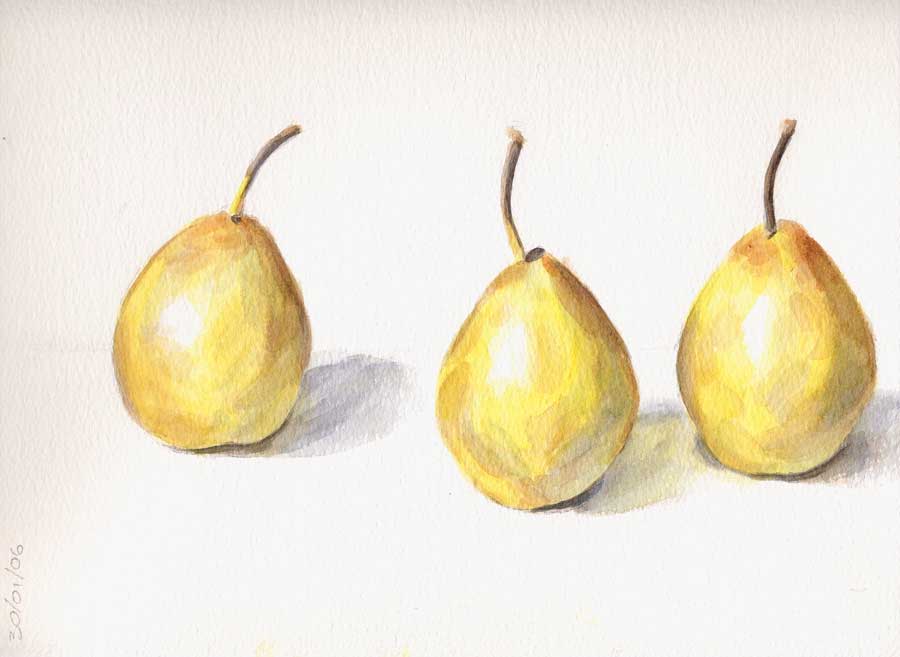
Apropos the reservations expressed in the previous post about the efficacy of using photography to represent certain aspects of the essential pearness of pears & specific physical qualities of the pears in question, I decided to make a couple of studies in order address my dissatisfaction with the results achieved using that particular medium, the first in graphite & the second in watercolour. Both, in their technical realization of form by a process of layering & accretion of visual information over a period of intense contemplation, scrutiny & decision-making, & by virtue of their own physical presence (not fully communicable here in a virtual context, alas), come closer in feeling and aesthetic to my original intention, whatever, ultimately, their sketchy nature & quality or absence of: undoubtedly, there is some form of virtue, some purpose, to be gained from the ‘hard(er)-won image’, it seems.


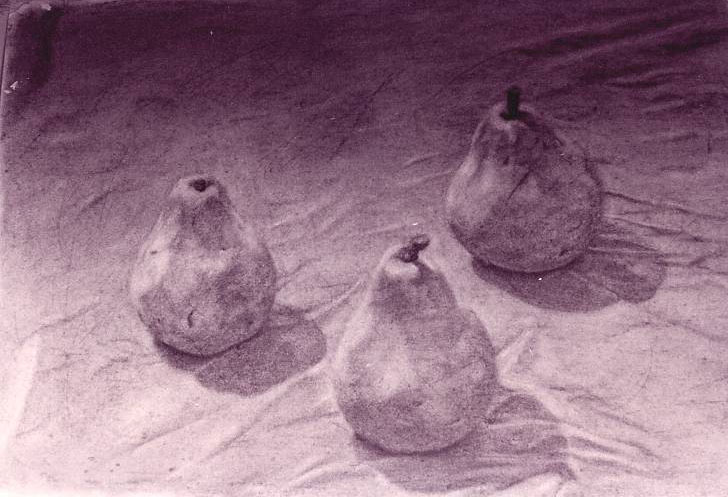
Below is featured a large-scale charcoal drawing of some Comice pears made some years ago during the course of my undergraduate studies, which seems to illustrate a much deeper level of engagement with the subject & more profound aesthetic experience altogether. This piece utilizes gorgeous, heavyweight Fabriano ‘Rosaspina’ paper, intended for printmaking but wonderfully receptive as a support for charcoal too, the surface of which breaks down easily to allow access to an underlying soft, crumbly texture perfect for retaining the marks of a drawing’s process, a record of its making and revisions (the drawing in question, like many of its contemporary fellows, was heavily worked over a period of time), layers of memory fixed in physical form, the scoring of the surface echoing that occurring on the pears with the passage of time, becoming a particular physical aspect of the drawing-as-an-object (as opposed to it being ‘merely’ two-dimensional) and incidentally giving the drawing something of the appearance of – perhaps somewhat ironically – an aged photograph, transparency or grainy film still. More of such work can be found on my art & design website, in the drawings gallery via the home page.


Below is featured a large-scale charcoal drawing of some Comice pears made some years ago during the course of my undergraduate studies, which seems to illustrate a much deeper level of engagement with the subject & more profound aesthetic experience altogether. This piece utilizes gorgeous, heavyweight Fabriano ‘Rosaspina’ paper, intended for printmaking but wonderfully receptive as a support for charcoal too, the surface of which breaks down easily to allow access to an underlying soft, crumbly texture perfect for retaining the marks of a drawing’s process, a record of its making and revisions (the drawing in question, like many of its contemporary fellows, was heavily worked over a period of time), layers of memory fixed in physical form, the scoring of the surface echoing that occurring on the pears with the passage of time, becoming a particular physical aspect of the drawing-as-an-object (as opposed to it being ‘merely’ two-dimensional) and incidentally giving the drawing something of the appearance of – perhaps somewhat ironically – an aged photograph, transparency or grainy film still. More of such work can be found on my art & design website, in the drawings gallery via the home page.
…And Pears
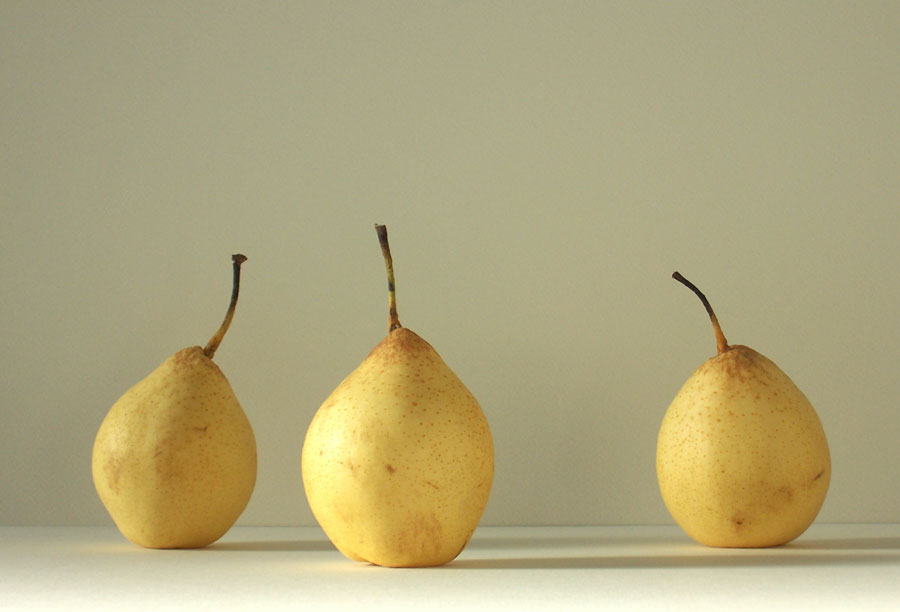
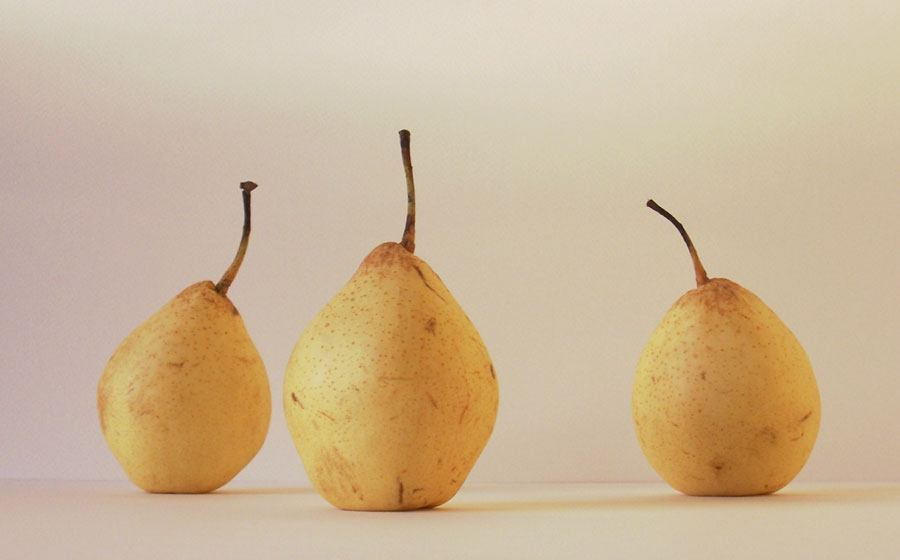
Finally removed those Chinese 'Ya' pears (see earlier post) from their protective cocoons & photographically explored their form & spatial relationships between them in a variety of natural lighting conditions (different times of the day, angles of light, different rooms). I must admit to finding these images unsatisfactory on a number of levels, not least in the failure to adequately capture the subtle beauty of the surface colour of the pears, a gorgeous pale, creamy gold, to which I was primarily attracted in the first instance: this, I believe, could have been better explored through the medium of oil paint, the consistency of which could have more appropriately represented what I can only describe as the creamy quality of the pears’ skin when experienced in the flesh.
Aesthetically, there remains something profoundly fascinating about their still, mute forms, their monumentality, their essential ‘pearness’ & ‘thing-in-itself’ quality, & I think this is communicated in some way by the photographs, yet photographing them seems such an unsatisfactory means of exploring & capturing this in comparison to drawing & painting, where time spent looking, in contemplation of formal and surface qualities seems much more rewarding and is capable of producing a more profound result.


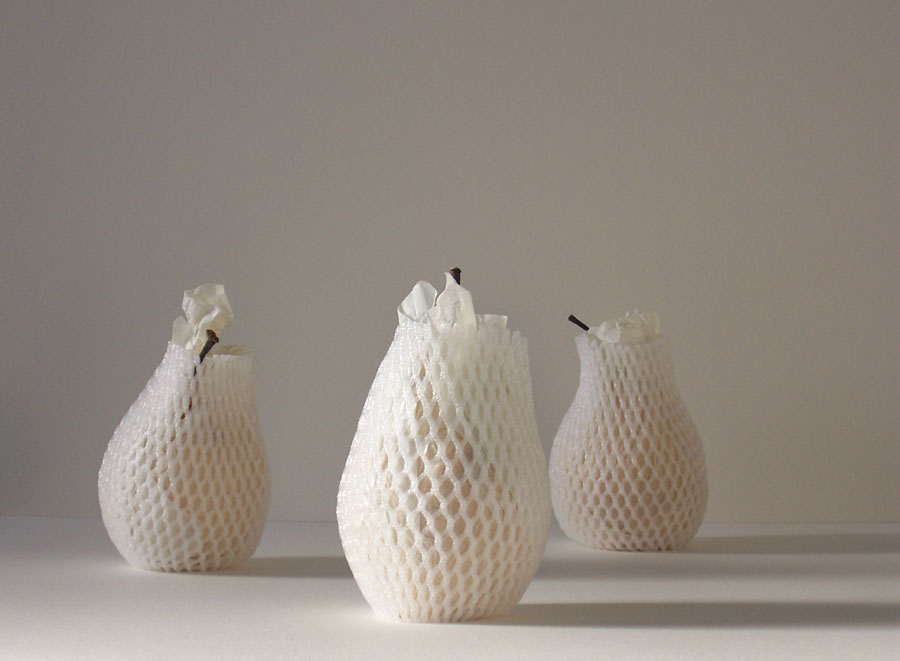
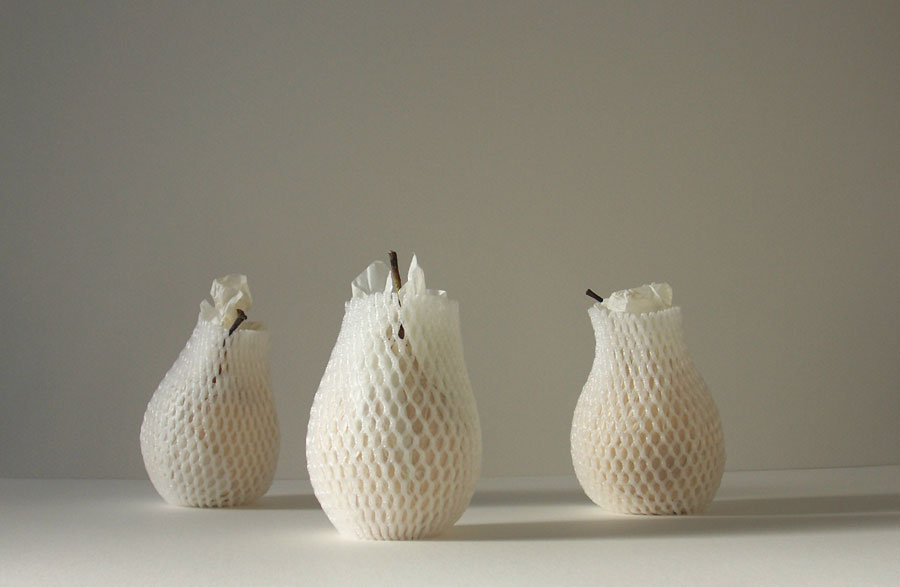
Given what I considered to be the failure of the camera to adequately communicate the surface colour and quality, I consequently decided the pears were photographically more interesting when wreathed once again in their protective coverings, & thus snapped a few more images. I enjoy here both the surface qualities and the hints as to what lies beneath, within: form and colour, for instance. Perhaps here photography, in representing the strangeness of something actually existing, achieves a better result than drawing or painting, whose results may appear more contrived or invented, self-consciously surreal even, and therefore less convincingly believable. As ever, it’s instructive to explore the potential of any given medium for achieving the most appropriate aesthetic resolution to a given visual problem.


Aesthetically, there remains something profoundly fascinating about their still, mute forms, their monumentality, their essential ‘pearness’ & ‘thing-in-itself’ quality, & I think this is communicated in some way by the photographs, yet photographing them seems such an unsatisfactory means of exploring & capturing this in comparison to drawing & painting, where time spent looking, in contemplation of formal and surface qualities seems much more rewarding and is capable of producing a more profound result.



Given what I considered to be the failure of the camera to adequately communicate the surface colour and quality, I consequently decided the pears were photographically more interesting when wreathed once again in their protective coverings, & thus snapped a few more images. I enjoy here both the surface qualities and the hints as to what lies beneath, within: form and colour, for instance. Perhaps here photography, in representing the strangeness of something actually existing, achieves a better result than drawing or painting, whose results may appear more contrived or invented, self-consciously surreal even, and therefore less convincingly believable. As ever, it’s instructive to explore the potential of any given medium for achieving the most appropriate aesthetic resolution to a given visual problem.

Friday, January 27, 2006
Strange Fruit
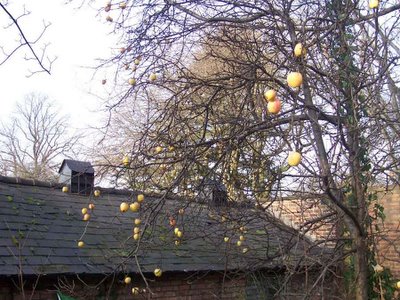
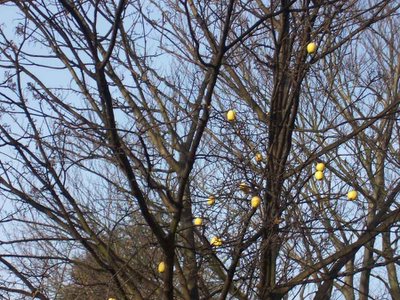
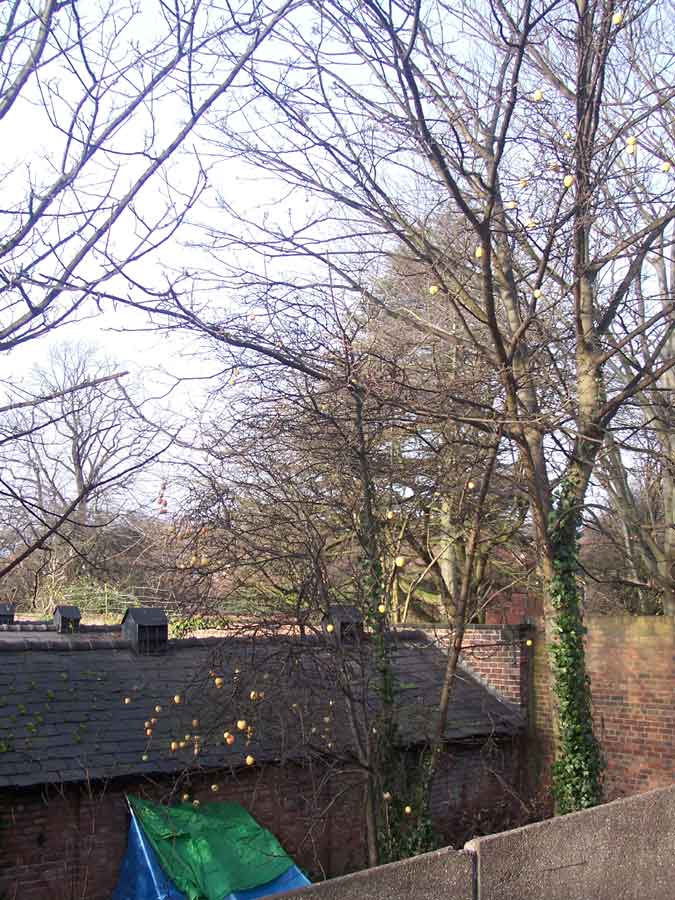
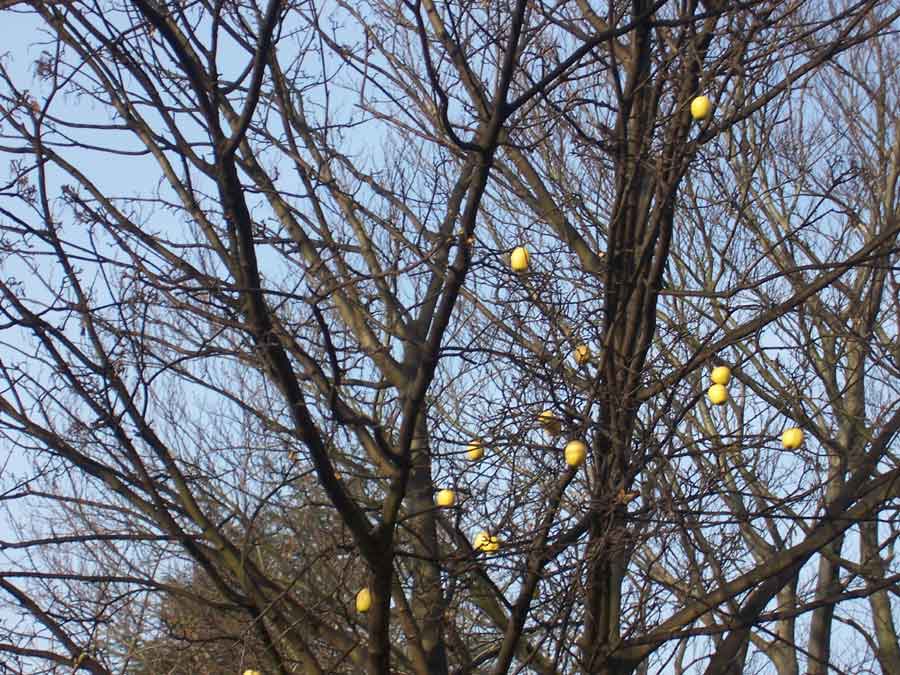
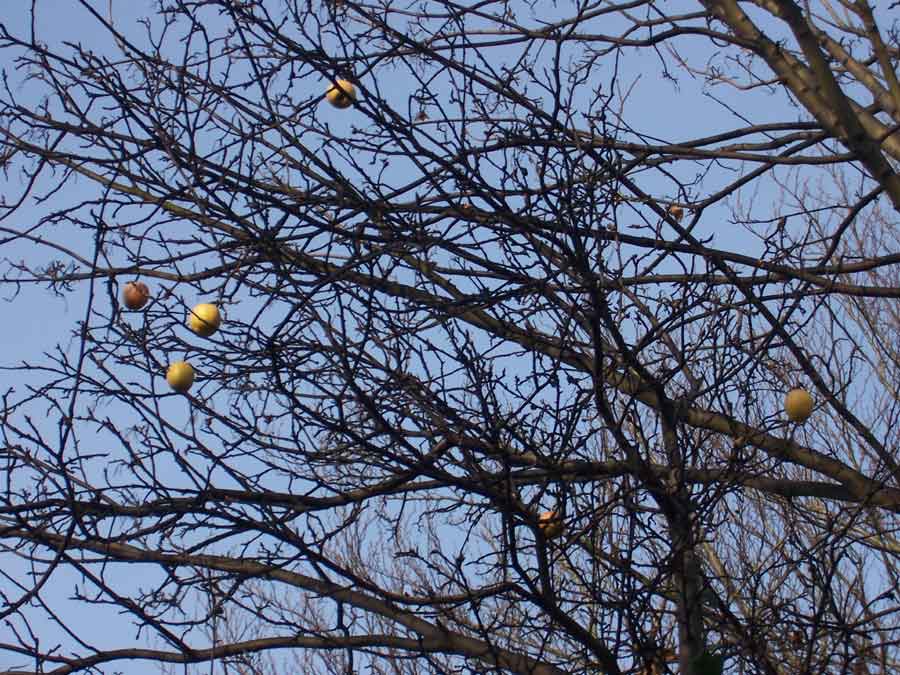
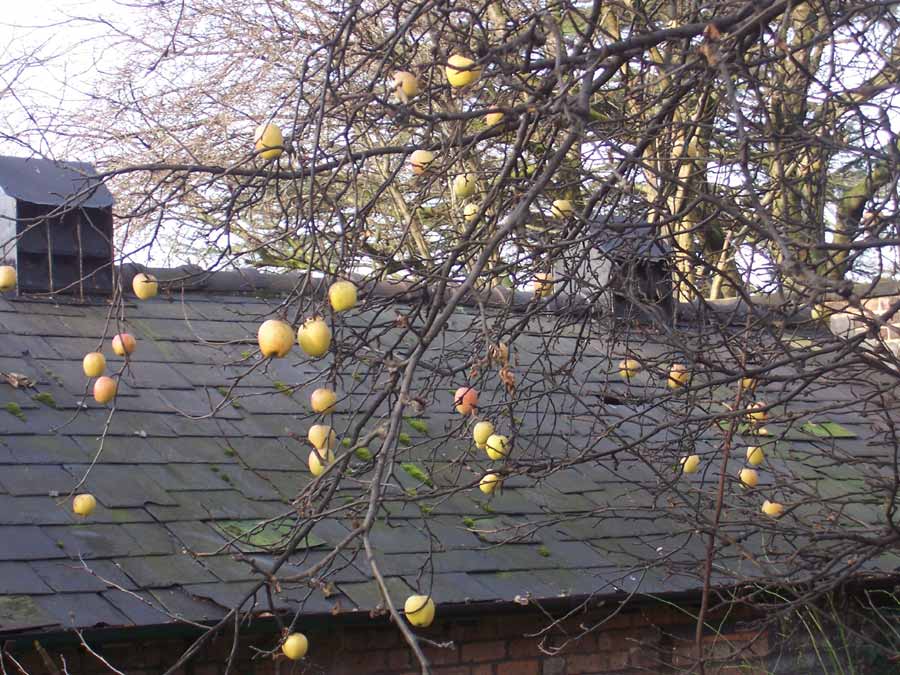
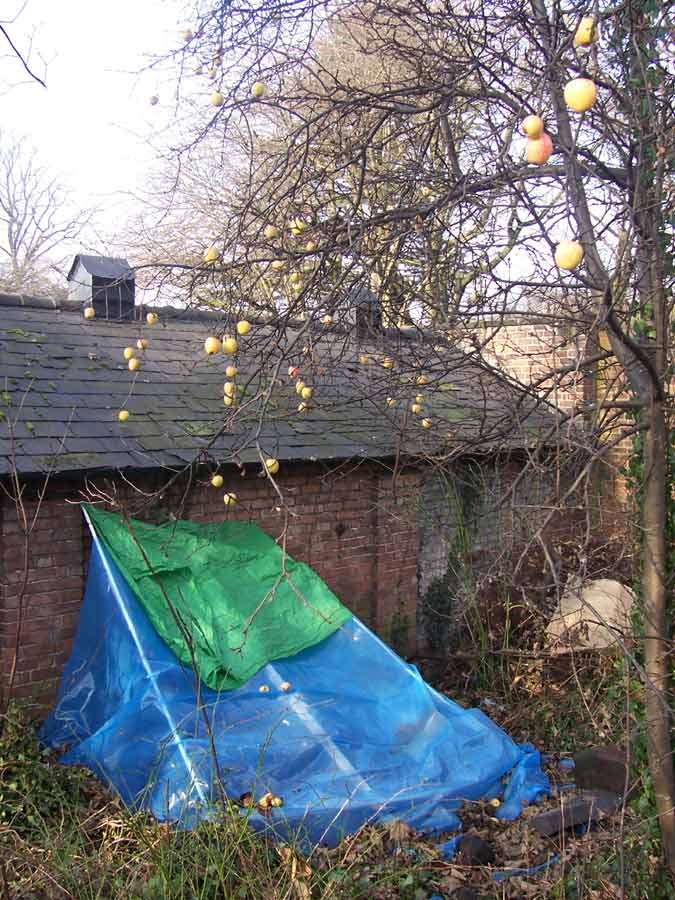
Here are a few photos I took in Chester recently, of something as simple as apples yet possessed of a strange, singular and remarkable beauty in the specific context in which they were observed, unique to my experience.
I had noticed this particular tree on a previous occasion, alone in itself in being bare of leaf, as one would expect given the time of year (mid to late Jan, in the UK), yet still bearing a substantial load of fruit, and resolved to capture this unusual phenomenon should it persist until at least our next encounter. It did, and here is presented the visual record. Given that one would expect such a tree to shed its fruit before its leaves, and during the autumn, it presented a strange, unseasonable sight indeed: I even wondered if perhaps the fruit was real or, rather, some form of art, and had been attached to the bare tree as a work of such, in order that we should question its existence. However, close inspection revealed the fruit to be real, illustrating that nature can often be stranger and more inexplicable than art or other human creation: for whatever reason, a substantial proportion of the tree’s bounty had yet to drop and remained attached to its branches, liberally scattered over its form. A few apples had fallen, as subsequently illustrated, but enough remained in situ to present a beguiling, fascinating spectacle.

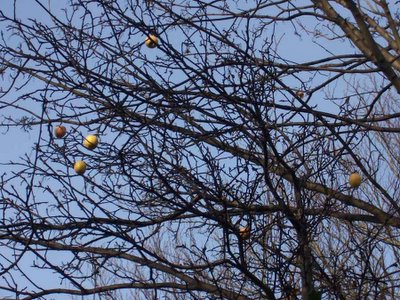
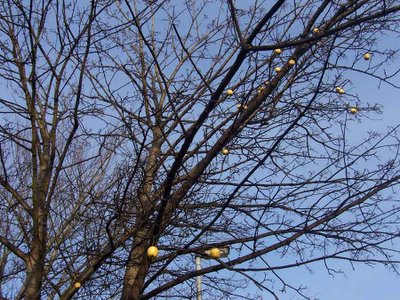
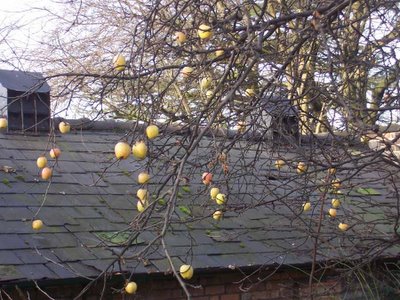
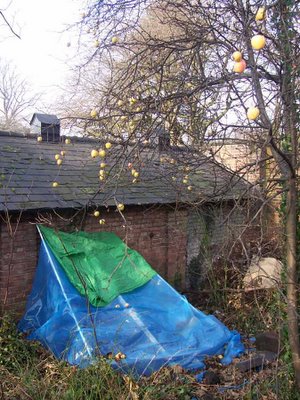
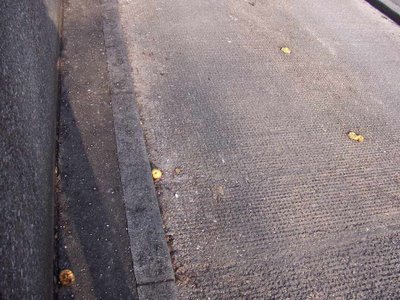
I had noticed this particular tree on a previous occasion, alone in itself in being bare of leaf, as one would expect given the time of year (mid to late Jan, in the UK), yet still bearing a substantial load of fruit, and resolved to capture this unusual phenomenon should it persist until at least our next encounter. It did, and here is presented the visual record. Given that one would expect such a tree to shed its fruit before its leaves, and during the autumn, it presented a strange, unseasonable sight indeed: I even wondered if perhaps the fruit was real or, rather, some form of art, and had been attached to the bare tree as a work of such, in order that we should question its existence. However, close inspection revealed the fruit to be real, illustrating that nature can often be stranger and more inexplicable than art or other human creation: for whatever reason, a substantial proportion of the tree’s bounty had yet to drop and remained attached to its branches, liberally scattered over its form. A few apples had fallen, as subsequently illustrated, but enough remained in situ to present a beguiling, fascinating spectacle.



Wednesday, January 18, 2006
Pure Pop Heaven (x2)
Just been listening to, and transported to a considerably more wondrous place by, My Bloody Valentine’s version of ‘We Have All the Time in the World’, the most blessed antidote to a waning, grey afternoon, such a gorgeous, swooning, perfect little shot of pop heaven, the aural equivalent of a Cadbury’s Caramel as it used to be advertised on TV…mmm. This had been preceded by ‘Loveless’ in its glorious entirety and a small selection of others of The Val’s very best. I’m still struck, the greater part of 15 years on, by how amazing ‘Loveless’ sounds whenever it’s heard, and how it seems to have rendered most subsequent guitar-based music somewhat redundant, how nothing has been quite able to scale its peak or match its sensual pleasures, however many have tried. I recall ‘Young Team’ and ‘CODY’-era Mogwai attempting something of a challenge, how exhilarating their quiet-loud-quiet or vice versa dynamic could on occasion be, yet ‘Loveless’ remains a monumental presence - an apotheosis of, apparently, art-rock, the genre of which the most recent Observer claims it to be a classic, occurring during the course of a recent live review of a Mogwai performance. Certainly, ‘Loveless’ is art, arguably one of very few examples of rock or popular music that may be considered such as it transcends itself. ‘Glider’, too, taking MBV’s sound to further extremes and whilst in an art context, is a damn fine piece of Minimalism.
Also, finally had the patience to wait for the download (still dawdling along at 56k here) of the animated movie, by Stephanie Anderson, a wonderful, beautiful watercolour work, accompanying Sol Seppy’s lovely song ‘Wonderland’, quite magical and enchanting both, and more so in perfect combination, floating along on a complementary drifting journey of transformation into light and air and wonder. You can download the movie via here (where there’s a brief, delightfully apposite description of the effect of hearing the song!), and I recommend that you should, as there is absolutely no reason not to and it will make your world a much better place and you a much lovelier person. There’s also an interesting article about Stephanie Anderson and her animation for ‘Wonderland’ here, and this is a still from the movie as an appetizer.

And, yes, this blodge may well be in danger of becoming something of a cyber-shrine to Sol Seppy, but anything less would an unforgivable dereliction of duty.
Also, finally had the patience to wait for the download (still dawdling along at 56k here) of the animated movie, by Stephanie Anderson, a wonderful, beautiful watercolour work, accompanying Sol Seppy’s lovely song ‘Wonderland’, quite magical and enchanting both, and more so in perfect combination, floating along on a complementary drifting journey of transformation into light and air and wonder. You can download the movie via here (where there’s a brief, delightfully apposite description of the effect of hearing the song!), and I recommend that you should, as there is absolutely no reason not to and it will make your world a much better place and you a much lovelier person. There’s also an interesting article about Stephanie Anderson and her animation for ‘Wonderland’ here, and this is a still from the movie as an appetizer.

And, yes, this blodge may well be in danger of becoming something of a cyber-shrine to Sol Seppy, but anything less would an unforgivable dereliction of duty.
Tuesday, January 17, 2006
Alt. Pear Photos
I’ve long been interested in the aesthetic, formal properties of pears as subjects for visual exploration and, as a result, they’ve featured in countless drawings and paintings over a number of years: some of these, indeed, may be found on my website (now defunct), in both the drawings and paintings galleries.
Recently attracted to a new discovery on the pear scene, named ‘Ya’ or known as snow pears and apparently from China, in a local greengrocers, I was inspired to invest in a few for modelling purposes, keen again to explore the possibilities offered by the new camera.
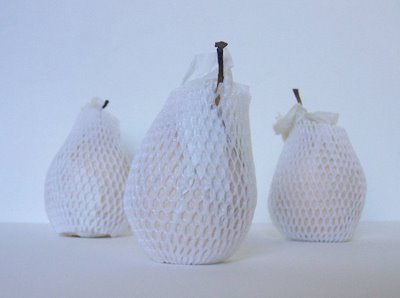
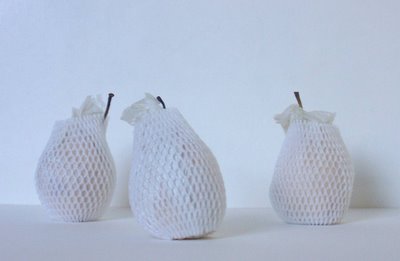
The pears themselves have beautiful cream, pale golden coloured skins, and I wished I had made their acquaintance years ago when making a long series of still life paintings on/in textured white grounds/spaces: their quiet tonal subtleties would have complemented each other most harmoniously. However, upon returning home, I realised just how visually arresting and intriguing they appeared as bought - wrapped in a layer of paper and then what appear like little thermal jackets for want of a more appropriate description (string vests?!). The fact that both the paper and outer protective layer happen to be white made them all the more attractive to me for the visual purposes to which I intended to put the pears, even more so given the slight translucency of the paper and wonderful texture of the ‘jackets’, as both the manifest working in a process of layering, offering hints as to the nature and accumulation of those below the surface, and with Braque-like textured, ‘tactile spaces’ (in the form of paint and collaged elements) have been significant aspects of my painting practice and concerns since undergraduate times.
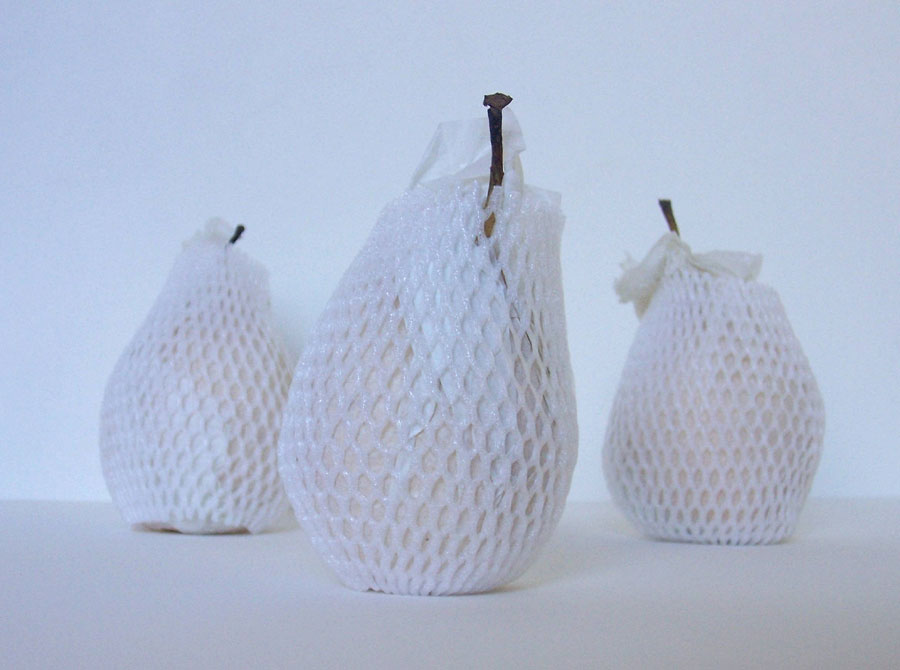
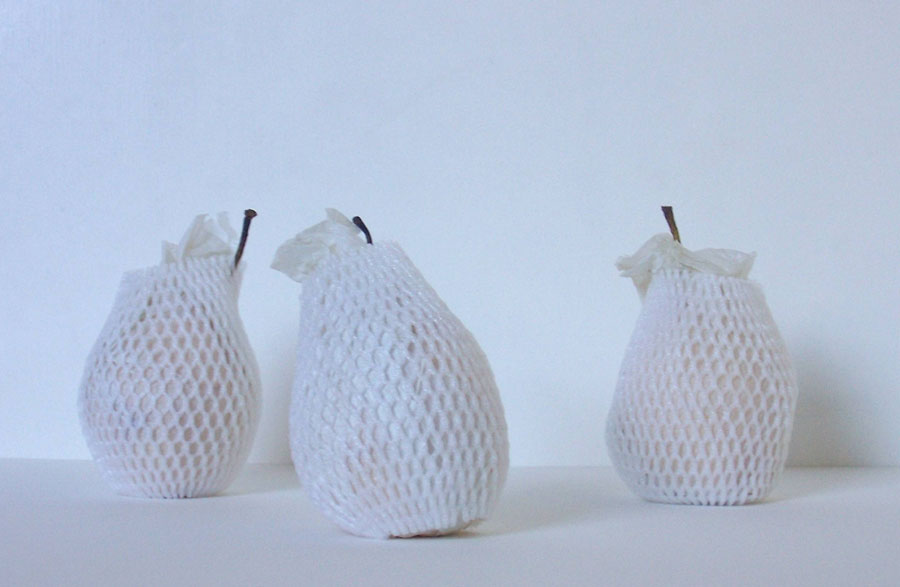
Anyway, thus far, since Saturday – whilst awaiting the availability of sufficient light in which to adequately photograph (within the depths of January in the UK, after all), trying to avoid the use of flash - I’ve only managed to produce images of the pears still clothed in their wrappings. Some were taken in an even light against a white ground and others in a brief sunlit interlude, again against white but consequently bathed in a lovely golden glow and also highlit in a manner which emphasizes the pears’ form. I must admit to being most inspired by the textured surfaces, which invest the pears with a certain sense of strangeness and difference, whilst not detracting from their essential formal qualities as pears-in-themselves.

Recently attracted to a new discovery on the pear scene, named ‘Ya’ or known as snow pears and apparently from China, in a local greengrocers, I was inspired to invest in a few for modelling purposes, keen again to explore the possibilities offered by the new camera.
The pears themselves have beautiful cream, pale golden coloured skins, and I wished I had made their acquaintance years ago when making a long series of still life paintings on/in textured white grounds/spaces: their quiet tonal subtleties would have complemented each other most harmoniously. However, upon returning home, I realised just how visually arresting and intriguing they appeared as bought - wrapped in a layer of paper and then what appear like little thermal jackets for want of a more appropriate description (string vests?!). The fact that both the paper and outer protective layer happen to be white made them all the more attractive to me for the visual purposes to which I intended to put the pears, even more so given the slight translucency of the paper and wonderful texture of the ‘jackets’, as both the manifest working in a process of layering, offering hints as to the nature and accumulation of those below the surface, and with Braque-like textured, ‘tactile spaces’ (in the form of paint and collaged elements) have been significant aspects of my painting practice and concerns since undergraduate times.
Anyway, thus far, since Saturday – whilst awaiting the availability of sufficient light in which to adequately photograph (within the depths of January in the UK, after all), trying to avoid the use of flash - I’ve only managed to produce images of the pears still clothed in their wrappings. Some were taken in an even light against a white ground and others in a brief sunlit interlude, again against white but consequently bathed in a lovely golden glow and also highlit in a manner which emphasizes the pears’ form. I must admit to being most inspired by the textured surfaces, which invest the pears with a certain sense of strangeness and difference, whilst not detracting from their essential formal qualities as pears-in-themselves.


Stoner
Recently invested in a post-Xmas present to self in the form of a new digital camera, nothing particularly extravagant but the sort of kit that will probably be able to do a decent enough job, and which has already proved an inspiration to visual thinking & making some form of work.
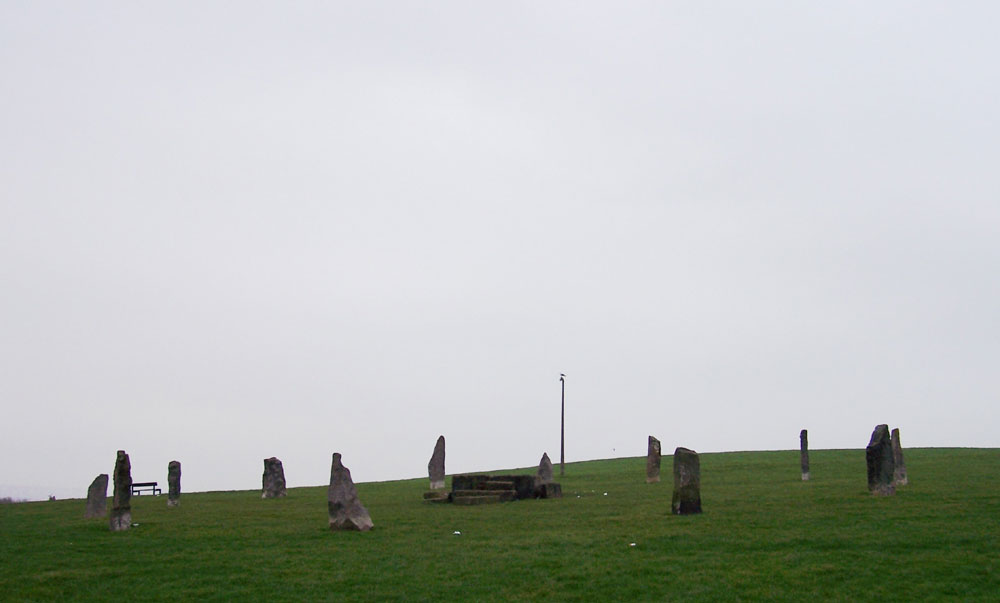
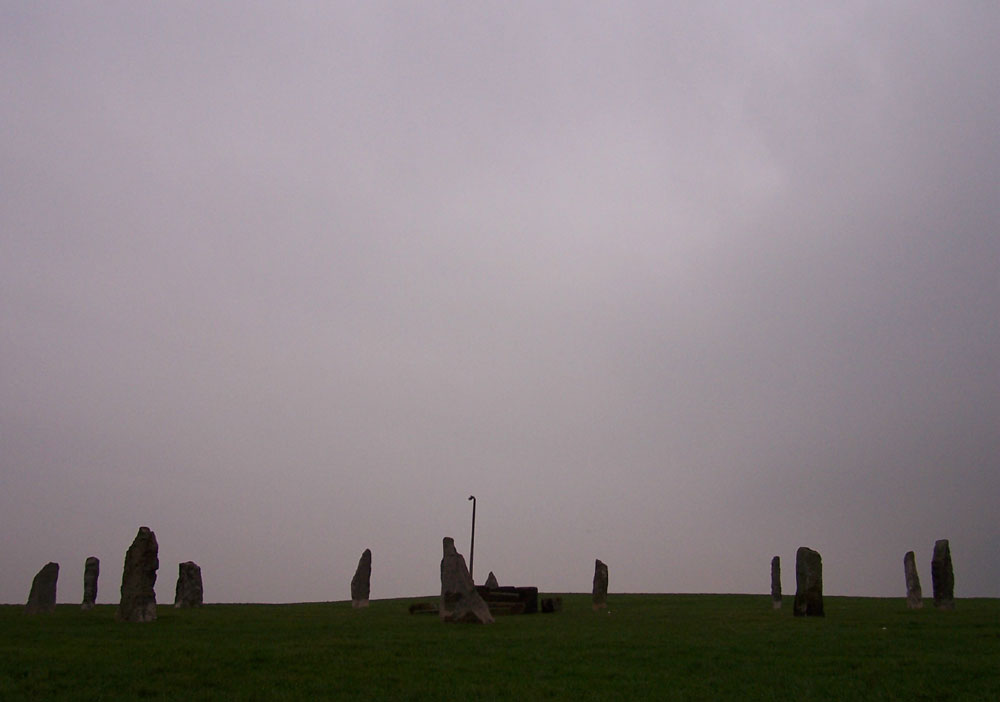
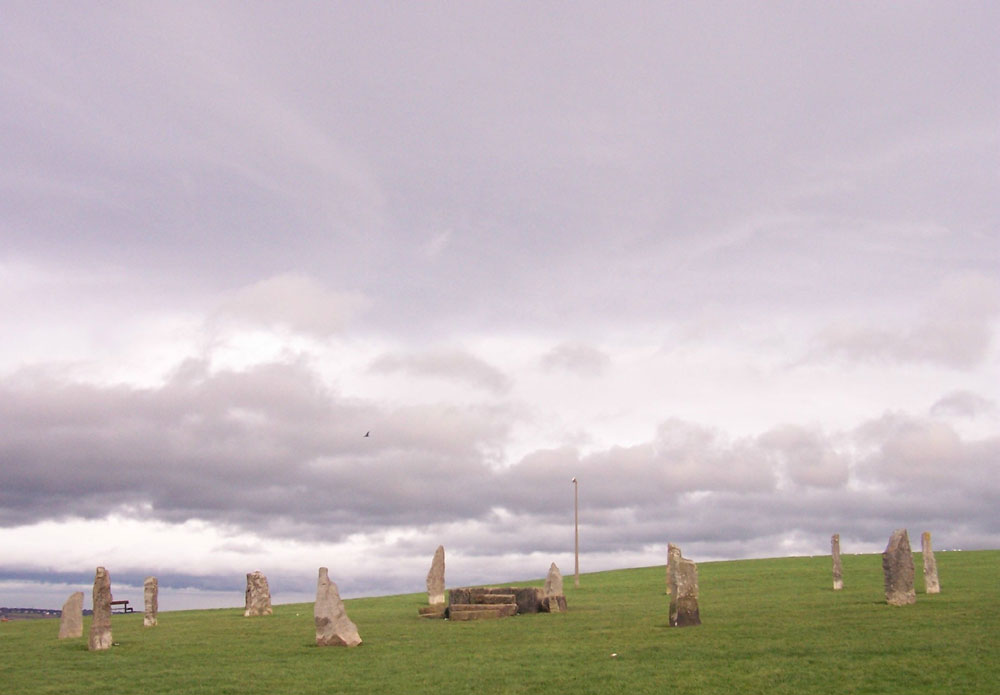
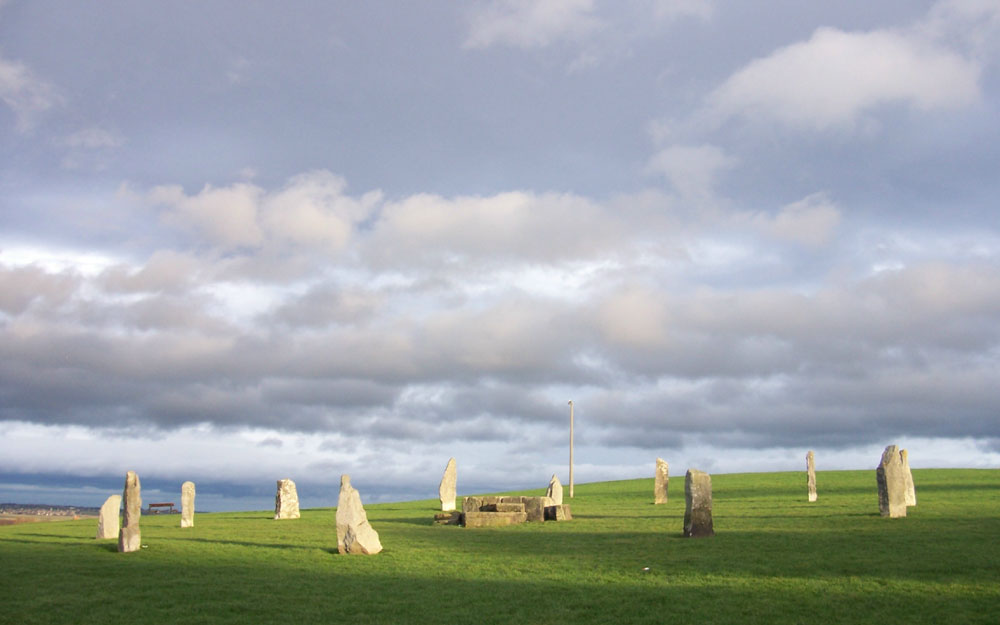
Apropos the earlier post about the ongoing photographic project engaged in by a character in the film ‘Smoke’, I shot some pictures of a local stone circle (decorative rather than of any historical or particular symbolic significance) over a period of a few days under a range of different atmospheric & weather conditions, managing to capture a variety of results: the subject, indeed, is the sky rather than the stones, which merely serve as a pretext for such explorations, although their appearance is of course effected and changed, their forms & surfaces rendered correspondingly more eloquent or mute, animated or brooding, by the variations in the former. The pictorial space too is subject to some change, alternately open & wide, infinite, or closed-in & somewhat oppressive, although the physical space described by the stones themselves remains constant, of course.
The selection of photos included here were taken on January days of (1) low, thick, persistent cloud-mist as the murky light faded further & the encroaching, heavy gloom soon became all-encompassing; (2) dramatic cloud formations & intermittent flashes of sunlight; & (3) a clear, bright, sunny day with, in the late afternoon, the moon having become visible in the sky as the sun began to set.
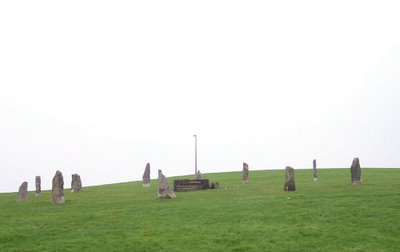
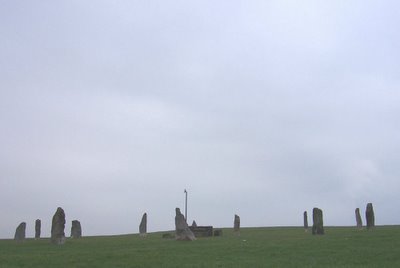
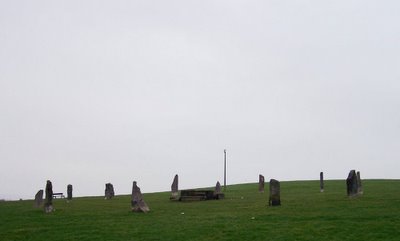
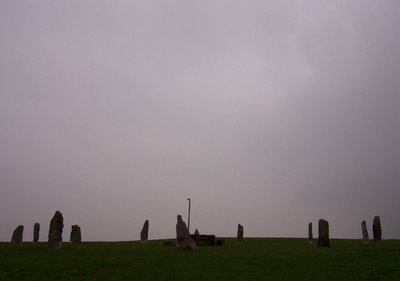
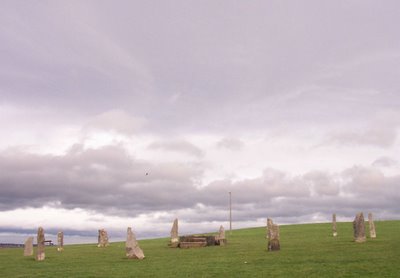

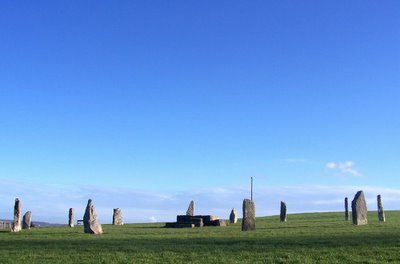
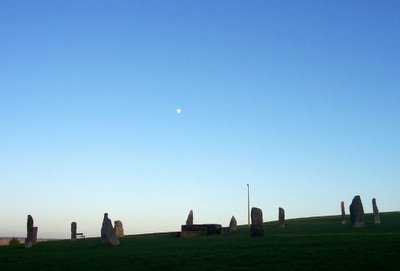
Apropos the earlier post about the ongoing photographic project engaged in by a character in the film ‘Smoke’, I shot some pictures of a local stone circle (decorative rather than of any historical or particular symbolic significance) over a period of a few days under a range of different atmospheric & weather conditions, managing to capture a variety of results: the subject, indeed, is the sky rather than the stones, which merely serve as a pretext for such explorations, although their appearance is of course effected and changed, their forms & surfaces rendered correspondingly more eloquent or mute, animated or brooding, by the variations in the former. The pictorial space too is subject to some change, alternately open & wide, infinite, or closed-in & somewhat oppressive, although the physical space described by the stones themselves remains constant, of course.
The selection of photos included here were taken on January days of (1) low, thick, persistent cloud-mist as the murky light faded further & the encroaching, heavy gloom soon became all-encompassing; (2) dramatic cloud formations & intermittent flashes of sunlight; & (3) a clear, bright, sunny day with, in the late afternoon, the moon having become visible in the sky as the sun began to set.
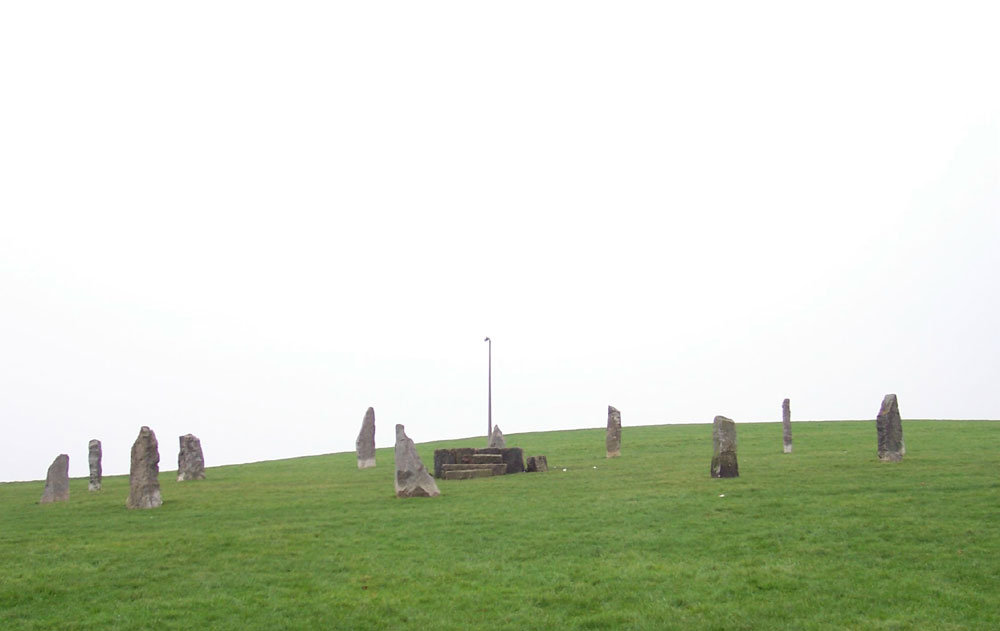



Saturday, January 07, 2006
Epiphany
Happened to notice on Thursday night that Friday the 6th was the feast of the Epiphany, & joshingly wondered if one such would occur on the day, feeling in need of such, some sign to suggest that it might be worth going on. Amazingly, wonderfully, it did happen, in the form of the revelation of the music of Sol Seppy. A new phenomenon to yours truly, I’d spotted a mention of ‘their’ existence in last Sunday’s Times, being intrigued in that the band was essentially Sophie Michalitsianos, a name lately associated with Sparklehorse & a contributor to the many-splendoured and much-loved albums ‘Good Morning Spider’ & ‘It’s a Wonderful Life’. Yesterday, I finally remembered to get around to having a quick surf in search of some more info to flesh out this tantalising titbit and, so doing, discovered the existence of the official Sol Seppy website, to which I naturally made suitable haste, & there finding a selection of listenable tunes. All have their own individual charming delights, which I would recommend unreservedly that you should sample your good self, dear reader, but, in particular, ‘Move’ & the appropriately-titled ‘Slo Fuzz’ were true epiphanies, an aural experience I was quite unprepared for the wonders of: the former exploding, swarming around inside the head like My Bloody Valentine reincarnate (& I remain more fond of 'Loveless' than most music heard before or since), before changing down into a trippy & acoustic gear, echoes of Garbage dynamically, perhaps, but mercifully less metallic overall & with lots of additional lovely Sparklehorsey-type textures such as cellos & wheezing harmoniums, an incredible noise; & the latter, heavenly, floating along over a deep drone, also recalling pleasant reminders of MBV, again texturally rich, gorgeously glittering & sparkly. Most enamoured of Sophie’s voice too, whose accent seems somewhat to recall that of The Sunday’s Harriet but has a seductive personality all its own. All in all, a wondrous, revelatory sonic experience – a true epiphany indeed - & one I’m most keen to sample much more of very soon. The album, 'The Bells of 1 2', is apparently due in Feb: I can’t wait, but, for the time being, at least there’s those 4 tunes to illuminate the gloom of the dark January days & inspire hope.
Subscribe to:
Posts (Atom)