Showing posts with label 1970s nostalgia. Show all posts

Friday, March 13, 2020

The Second Half of an Update


Back after our half-time orange, the Seventies project now takes a turn into what has proved to be an abiding area of interest from the middle of that decade to the present, namely European football.
I’ve blogged on this subject previously and extensively, but, basically, I got into football via the 1974 World Cup and became immersed in the game in the autumn of that year with the domestic season and the exploits of a selection of British clubs in the various continental competitions for which they had qualified. However, what most appealed, mostly, when encountered via the results pages of the Daily Mirror newspaper and, in particular, Shoot! magazine were the identities of these teams’ opponents and, in an unwitting act of un-nationalism, such gloriously exotic names became immediate and enduring favourites.

Two of these happened to feature as Liverpool’s opponents in the opening two rounds of the now sadly defunct and much-lamented European Cup-Winners’ Cup, which was pure coincidence but nevertheless acts as the inspiration for the following two drawings.

First of all, the magnificently-monikered Strømsgodset, from Drammen in Norway, presented themselves as an attractive proposition and an underdog to be embraced after receiving an 11 - 0 pasting at Anfield in the first leg of their First Round tie. Prior to the return fixture, which big match was scheduled to take place in the national Ulleval Stadium in Oslo, a particularly wet Norwegian autumn had rendered the pitch somewhat churned-up and waterlogged, apparently to such an extent that the match was under threat of postponement.

Liverpool’s star striker duo of John Toshack and Kevin Keegan - the latter of whom we’ve already encountered twice earlier in this project - were sent out to perform publicity duties and be pictured ‘testing’ the state of the surface, albeit in their civvies (admire those fashions, those flares, if you will) rather than playing kit, and the source image of this media performance provides grist to the artistic mill in this instance. Much to the Liverpool contingent’s disbelief, as subsequently reported, the match did go ahead on the ‘cow field’ and our heroes Strømsgodset managed an impressively doughty display to restrict their opponents to a mere single-goal victory on this occasion: since, they have maintained a place in my heart.


John Toshack and Kevin Keegan, Oslo,October 1974
graphite & putty eraser on ‘Seawhite’ cartridge paper/42 x 30cm

Liverpool’s reward was to progress to a Second Round meeting with Hungary’s wonderful Ferencváros, one of a number of attractive clubs from Budapest, who had previously eliminated Cardiff City from the competition after a fabulous 4 - 1 victory on Welsh soil (as I was to become a Wrexham FC supporter, historically this defeat of the most despised of rivals is thus doubly enjoyable), and it is the first leg of this match, on Merseyside, that provides the source image for the next drawing, of Liverpool, and Kevin Keegan (again!) in particular, pictured attacking the Ferencváros goal. Keegan scored on the night to give his team a lead they held until the final minute, when Maté equalised for our Hungarian heroes, a goal that ultimately proved decisive as, following a scoreless return match, Ferencváros progressed to the next round courtesy of the ‘away goals rule’ in the event of a tied aggregate, a journey that subsequently continued to the Final of the 1974 - 75 season’s Cup-Winners’, where they sadly succumbed 0 - 3 to the then-Soviet Union’s Dynamo Kiev, one of the great clubs of European football but nowhere near one of my particular favourites, even from the Ukraine.
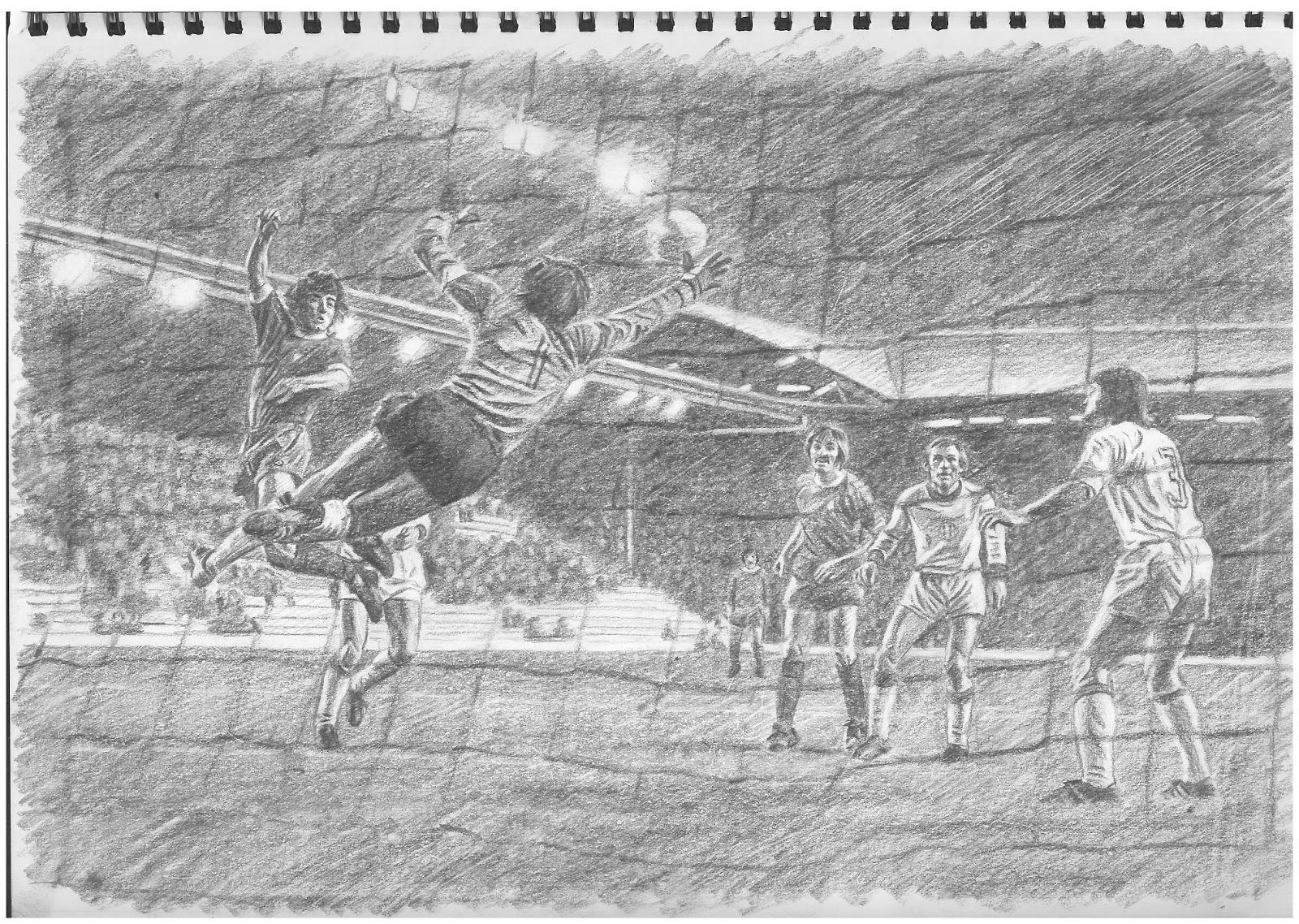

Liverpool v Ferencváros, ECWC, October 1974
graphite & putty eraser on ‘Seawhite’ cartridge paper/42 x 30cm

My first taste of live European match action came in September 1978, when I attended the Wrexham v NK Rijeka - then of Yugoslavia - European Cup-Winners’ Cup First Round, Second Leg, tie at the Racecourse Ground, where the hosts could retrieve only two of a three-goal First Leg deficit and thus departed the competition at the initial stage.
The next season saw Wrexham return to the Cup-Winners’ Cup and being drawn to play East Germany’s 1FC Magdeburg, winners of the trophy in 1974, in the First Round. As we were, of course, all schoolboy Communists at this time, such matches had a palpable exotic glamour to them, to yours truly at least, and to be there was magical indeed, to witness the action unfolding, beneath floodlights. The first leg took place at the Racecourse and it is this match that provides the source image for the following drawing, depicting Wrexham’s Steve Fox (far right) in the act of scoring his team’s equalising goal to make the score on the night 2 - 2: this was a proper cup tie of the legendary sort - Wrexham establishing a very early lead before Magdeburg recovered to 2 - 1 ahead by half-time. Fox’s goal arrived late but there still remained enough time for Wrexham to score a winning goal to take a 3 - 2 advantage to East Germany for the rematch (lost, unfortunately, 2 - 5 after extra time to again fall at the first hurdle), and it is such occasions that form the lasting memories, which those of us of a nostalgic inclination can recall fondly whilst they contribute to the personal cultural store.


Steve Fox scores, Wrexham v 1FC Magdeburg, ECWC, September 1979
graphite & putty eraser on ‘Seawhite’ cartridge paper/42 x 30cm

Next up, another sport-themed source image, this one of the author pictured some time at that particularly awkward age around the threshold of one’s teens, captured for posterity in sun-drenched colour. There is no requirement to add anything further here.


Tennis Self-Portrait, 1970s
coloured pencil on ‘Seawhite’ cartridge paper/30 x 42cm

Further to my inglorious history of being pictured pulling faces (or, perhaps, pulling faces when being photographed), the following drawing is based on a source image that is up there with the very best/worst. Taken for and published by a local newspaper in the summer of 1976, it depicts three of St Mary’s school’s ‘Prize Pupils’ clutching the books with which their academic achievements had been rewarded. The apparent loon grinning maniacally in the centre of the group of course made his parents very proud.


‘“The Prize Pupils”, 1976’
graphite & putty eraser on ‘Seawhite’ cartridge paper/30 x 42cm


Friday, January 10, 2020

Post-Yuletide Update


One of the benefits of the holiday-from-the-day-job season, at least in academic circles, is a two-week break that, among other things, allows more quality time, some of it even during daylight hours, to get some painting and/or drawing done, and this year I’ve used such opportunity to continue with the Seventies project.
The first drawing to be processed follows on from the previous one of ‘The Protectors’ in that it features a pair of representations of the picture sleeves of the 7″ vinyl record of Tony Christie‘s ‘Avenues and Alleyways’, which song provided the memorable theme tune to that particular television series. This still life is in fact something of a concoction, with images of the respective record covers sourced from the internet, drawn from prints of the images and then transformed into objects with reference to an arrangement of two physical 7″ single records in picture covers, the random choice of which, in terms of the music contained within, are individually and collectively about as far from the Christie song and production as it’s possible to imagine, even if all three are enduring classics of their kind!

‘Tony Christie “Avenues and Alleyways” 7-inch Picture Sleeves’
 coloured pencil and putty eraser on Seawhite cartridge paper/
42 x 30cm


still life composition for ‘Avenues and Alleyways’, featuring the 7″ picture sleeves of Cabaret Voltaire’s ‘Nag Nag Nag’ and the Gang of Four’s ‘Damaged Good’ EP

After ‘The Protectors’, one remembers the capers of Roger Moore and Tony Curtis as Lord Brett Sinclair and Danny Wilde, ‘The Persuaders!’ and the private detective team of ‘Randall and Hopkirk (Deceased)’ as played by Mike Pratt (on the right of the image represented in the drawing) and Kenneth Cope in white-suited ‘ghost’ mode, both of which series obviously kept me interested and entertained enough to remain in the memory bank.


‘The Persuaders!’
graphite and putty eraser on Seawhite cartridge paper/42 x 30cm


‘Randall and Hopkirk (Deceased)’
graphite and putty eraser on Seawhite cartridge paper/42 x 30cm


‘Randall and Hopkirk (Deceased)’ was remade in the 1990s starring north east Surrealist duo Vic Reeves (Jim Moir) and Bob Mortimer and this geographical and regional accent fact inspires thoughts of the Newcastle-set ‘Whatever Happened to the Likely Lads?’, which was a 1970s sequel to the original Sixties British television sitcom ‘The Likely Lads’, both starring James Bolam and Rodney Bewes, and also spawned a feature film that I recall with more clarity than others and again featured a memorable theme song including the lyric “It’s the only thing to look forward to, the past”, of particular resonance in the context of the Seventies project! The Likely Lads certainly seems to have remained an enduring favourite, a significant part of British popular culture and represents a vivid marker of its times.


‘Whatever Happened to the Likely Lads?’
graphite and putty eraser on Seawhite cartridge paper/42 x 30cm

‘Billy Liar’ is a fictional character who’s long held a place in my affections, via Keith Waterhouse’s novel (and its ‘…on the Moon’ sequel) and the 1960s film starring Tom Courtney in the title role, who I always ‘imagine’ since, but I have a dimmer recollection of my first exposure being in fact a Seventies’ sitcom production, thus the drawing below features the actor Jeff Rawle in the eponymous role, represented as one of Billy’s heroic imaginary alter-egos, the President of Ambrosia or somesuch.


‘Billy Liar’
graphite and putty eraser on Seawhite cartridge paper/30 x 42cm

Finally, another sitcom dreamer, ‘Citizen Smith’, as played by Robert Lindsay, one of whom’s revolutionary rallying cries, “Power to the People”, seems so grimly ironic  in the light of the recent UK General Election resulting in the grotesque travesty of ‘the People’s PM’ representing ‘the People’s Government’, having been returned by a significant enough proportion of an ignorant and deluded electorate – I could rant on at inordinate length of my disgust and fear at the turn of political events in the UK but will end for now and remain focused on the creative, for it’s all we have left.


‘Citizen Smith’
graphite and putty eraser on Seawhite cartridge paper/30 x 42cm


Thursday, December 05, 2019

Adventures in Sci-Fi


'UFO'
Graphite and putty eraser on 'Seawhite' cartridge paper/42 x 30cm (A3)

Following on from the previous entry, the drawing above also features among its cast of human subjects the actress Gabrielle Drake, on this occasion represented in character as ‘Lt. (Gay) Ellis’ as she appeared in the early 1970s British television series ‘UFO’, which I recall as being a particular favourite of my young self at the time, quite possibly to the point of obsession, as I know I numbered among my substantial collection of ‘Dinky’ toy cars (a definite obsession) the range of three vehicles that were merchandised from the show, including the gold car of the platinum blond 'Commander Ed Straker' (played by Ed Bishop), who forms the central figure of the trio depicted. The portrait to the right is of the magnificently and memorably-named Vladek Sheybal, in his role of ‘Dr Doug Jackson’, who, in a curious coincidence, is recorded as appearing in 10 episodes of the total of 26 produced, as is/was Gabrielle Drake, who I must admit I had no recollection of, unlike her role in the previously-referenced ‘Kelly Monteith Show’: apparently, Drake and Sheybal only featured in 2 episodes together, 1970’s ‘Kill Straker!’ and the following year’s ‘Ordeal’.
I think it’s highly-probable that the attraction to Vladek Sheybal’s name was the precursor to my undimmed devotion to those of East European football clubs, easily imaginable as it is that it should belong to, for example, the surprise Bulgarian Cup winners of 1973 who subsequently made an obscure appearance in the following season’s European Cup-Winners’ Cup, perhaps going out of that much-missed competition after a hard-fought and unlucky defeat to AC Milan at the Second Round stage.
Whatever, ‘UFO’, however deeply buried in the recesses of the mind and undisturbed for many years, maintains its presence in the memory and the Seventies project has allowed it to see the light of day once again.

By those curious connections the mind whimsically makes, of its own accord, Ed Straker’s dyed blond hair referenced that of Gary Numan, pictured similarly on the cover of Tubeway Army’s ‘Replicas’ LP from 1979. Now, this was something of a surprise at the time as I distinctly recall seeing Tubeway Army making what was quite possibly their debut appearance on ‘Top of the Pops’, performing ‘Are ‘Friends’ Electric?’ one Thursday evening during the Spring of 1979 - it sparked something of a pro/con debate in John Rogers’ English class in school the following morning, I’m back there in the room - featuring a jet black-haired Numan as the front man, and it is this memory that forms the inspiration for the following drawing in the project, represented from a still taken from a still of a ‘Top of the Pops’ broadcast. Vividly remembered days, of youth, indeed.


'Tubeway Army, 'Are 'Friends' Electric?', Top of the Pops', 1979'
Graphite and putty eraser on 'Seawhite' cartridge paper/42 x 30cm (A3)

As an aside, it’s worth mentioning that, despite both of these fond (I suppose) memories, my interest in science fiction withered early and it’s never been rekindled, it’s just one of those things I can find no way into or seem to have any desire to.


Tuesday, November 19, 2019

Back in Time


The Seventies project continues here with a slight deviation from its course (which is pretty random!) to take into account a suitable period image of a subject who has ‘enjoyed’ recent topicality. Here is represented Neil Warnock – who last Monday mutually agreed to part ways with his most recent employer – as pictured some time between February 1972 and March 1975, when his football playing career took him to Scunthorpe United ( also the first club of recent subject Kevin Keegan) and long before he came to resemble Mrs Doubtfire: note the hairstyle as being particularly du jour.


‘Neil Warnock, Scunthorpe United (c. 1972 – 75)’
graphite and putty eraser on cartridge paper/30 x 21cm (A4)

Monday, November 18, 2019

Kenny Killed Us...


As mentioned at the conclusion of the previous entry, Kevin Keegan‘s replacement in the Liverpool FC team for the 1977-78 football season was Kenny Dalglish, on whose purchase the club didn’t stint in their pursuit of continued success, as might be gleaned from this portrait published within the pages of the match programme for the Wrexham v Liverpool Football League Cup quarter-final tie played at the Racecourse Ground on Tuesday, 17th January 1978.


This was a match at which I was fortunate to be present, a big occasion and distinct memory in a season of much excitement and great days/nights at Wrexham that season, competing that evening against the reigning domestic and European club champions. Alas, Liverpool and Kenny Dalglish in particular, were  to poop Wrexham’s giant-killing party by inflicting a 3 – 1 defeat not least courtesy of Dalglish scoring all three of his team’s goals, and here the Seventies project continues with a representation of the man celebrating one of his hat-trick during the course of the 90 minutes of the match. As Liverpool supporter John Peel‘s favourite player of the era, there’s thus a link between this and a previous subject to be featured in the project. As also mentioned before, Youtube footage of the highlights of the match and the damage done by Dalglish, is available).


‘Kenny Dalglish, Wrexham v Liverpool, 16/01/78’
Graphite and putty eraser on Seawhite cartidge paper/42 x 30cm (A3)
A tangible souvenir of the occasion, a portal to a variety of memories, here’s an image of the front cover of the match programme and also the rear, featuring the team line-ups, both full of fine players: if only Dixie McNeil, goalscorer par excellence, hadn’t been cup-tied and thus unavailable to represent Wrexham, though…(we can still dream of what might have been).