Showing posts with label Liverpool FC. Show all posts

Friday, March 13, 2020

The Second Half of an Update


Back after our half-time orange, the Seventies project now takes a turn into what has proved to be an abiding area of interest from the middle of that decade to the present, namely European football.
I’ve blogged on this subject previously and extensively, but, basically, I got into football via the 1974 World Cup and became immersed in the game in the autumn of that year with the domestic season and the exploits of a selection of British clubs in the various continental competitions for which they had qualified. However, what most appealed, mostly, when encountered via the results pages of the Daily Mirror newspaper and, in particular, Shoot! magazine were the identities of these teams’ opponents and, in an unwitting act of un-nationalism, such gloriously exotic names became immediate and enduring favourites.

Two of these happened to feature as Liverpool’s opponents in the opening two rounds of the now sadly defunct and much-lamented European Cup-Winners’ Cup, which was pure coincidence but nevertheless acts as the inspiration for the following two drawings.

First of all, the magnificently-monikered Strømsgodset, from Drammen in Norway, presented themselves as an attractive proposition and an underdog to be embraced after receiving an 11 - 0 pasting at Anfield in the first leg of their First Round tie. Prior to the return fixture, which big match was scheduled to take place in the national Ulleval Stadium in Oslo, a particularly wet Norwegian autumn had rendered the pitch somewhat churned-up and waterlogged, apparently to such an extent that the match was under threat of postponement.

Liverpool’s star striker duo of John Toshack and Kevin Keegan - the latter of whom we’ve already encountered twice earlier in this project - were sent out to perform publicity duties and be pictured ‘testing’ the state of the surface, albeit in their civvies (admire those fashions, those flares, if you will) rather than playing kit, and the source image of this media performance provides grist to the artistic mill in this instance. Much to the Liverpool contingent’s disbelief, as subsequently reported, the match did go ahead on the ‘cow field’ and our heroes Strømsgodset managed an impressively doughty display to restrict their opponents to a mere single-goal victory on this occasion: since, they have maintained a place in my heart.


John Toshack and Kevin Keegan, Oslo,October 1974
graphite & putty eraser on ‘Seawhite’ cartridge paper/42 x 30cm

Liverpool’s reward was to progress to a Second Round meeting with Hungary’s wonderful Ferencváros, one of a number of attractive clubs from Budapest, who had previously eliminated Cardiff City from the competition after a fabulous 4 - 1 victory on Welsh soil (as I was to become a Wrexham FC supporter, historically this defeat of the most despised of rivals is thus doubly enjoyable), and it is the first leg of this match, on Merseyside, that provides the source image for the next drawing, of Liverpool, and Kevin Keegan (again!) in particular, pictured attacking the Ferencváros goal. Keegan scored on the night to give his team a lead they held until the final minute, when Maté equalised for our Hungarian heroes, a goal that ultimately proved decisive as, following a scoreless return match, Ferencváros progressed to the next round courtesy of the ‘away goals rule’ in the event of a tied aggregate, a journey that subsequently continued to the Final of the 1974 - 75 season’s Cup-Winners’, where they sadly succumbed 0 - 3 to the then-Soviet Union’s Dynamo Kiev, one of the great clubs of European football but nowhere near one of my particular favourites, even from the Ukraine.
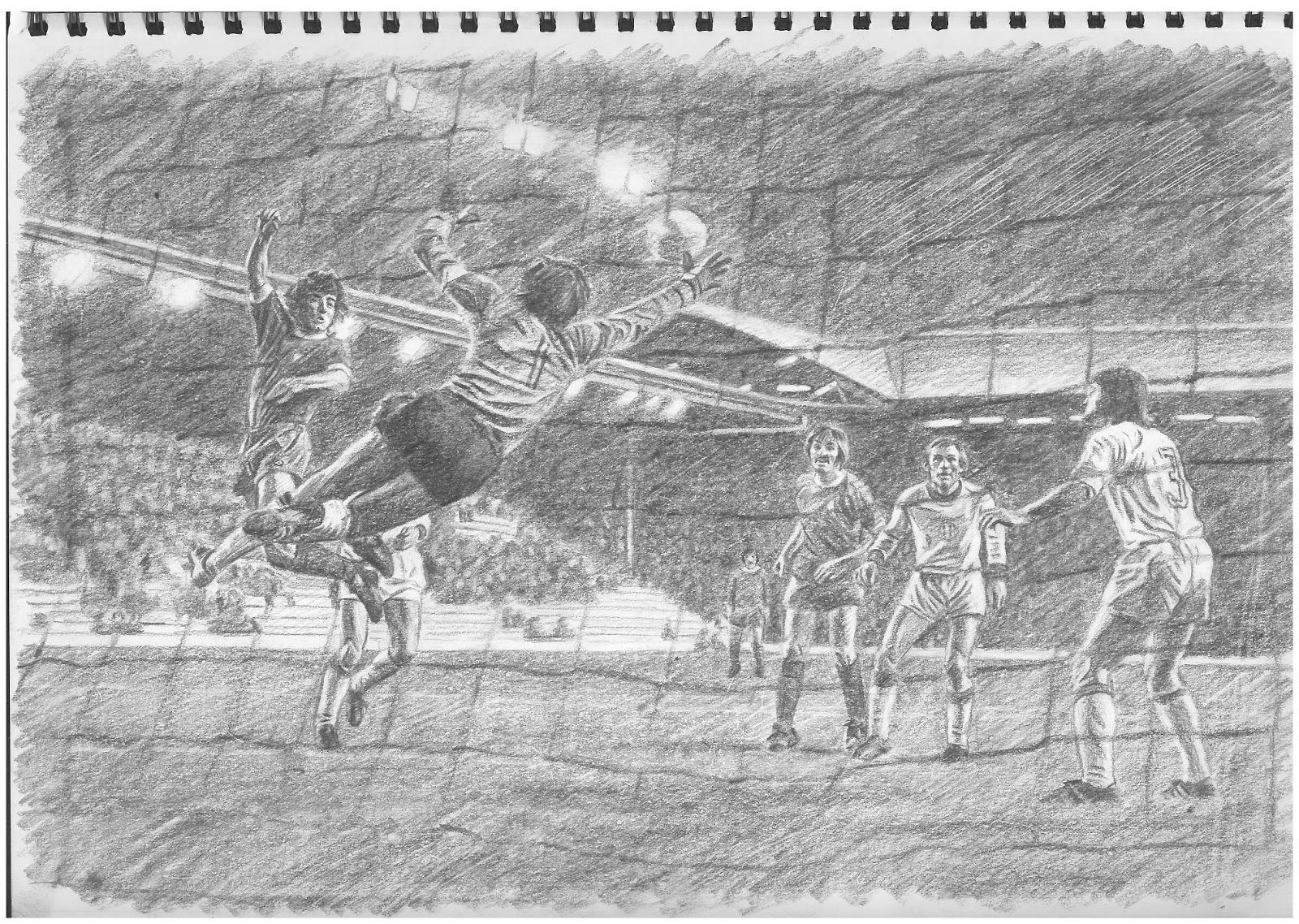

Liverpool v Ferencváros, ECWC, October 1974
graphite & putty eraser on ‘Seawhite’ cartridge paper/42 x 30cm

My first taste of live European match action came in September 1978, when I attended the Wrexham v NK Rijeka - then of Yugoslavia - European Cup-Winners’ Cup First Round, Second Leg, tie at the Racecourse Ground, where the hosts could retrieve only two of a three-goal First Leg deficit and thus departed the competition at the initial stage.
The next season saw Wrexham return to the Cup-Winners’ Cup and being drawn to play East Germany’s 1FC Magdeburg, winners of the trophy in 1974, in the First Round. As we were, of course, all schoolboy Communists at this time, such matches had a palpable exotic glamour to them, to yours truly at least, and to be there was magical indeed, to witness the action unfolding, beneath floodlights. The first leg took place at the Racecourse and it is this match that provides the source image for the following drawing, depicting Wrexham’s Steve Fox (far right) in the act of scoring his team’s equalising goal to make the score on the night 2 - 2: this was a proper cup tie of the legendary sort - Wrexham establishing a very early lead before Magdeburg recovered to 2 - 1 ahead by half-time. Fox’s goal arrived late but there still remained enough time for Wrexham to score a winning goal to take a 3 - 2 advantage to East Germany for the rematch (lost, unfortunately, 2 - 5 after extra time to again fall at the first hurdle), and it is such occasions that form the lasting memories, which those of us of a nostalgic inclination can recall fondly whilst they contribute to the personal cultural store.


Steve Fox scores, Wrexham v 1FC Magdeburg, ECWC, September 1979
graphite & putty eraser on ‘Seawhite’ cartridge paper/42 x 30cm

Next up, another sport-themed source image, this one of the author pictured some time at that particularly awkward age around the threshold of one’s teens, captured for posterity in sun-drenched colour. There is no requirement to add anything further here.


Tennis Self-Portrait, 1970s
coloured pencil on ‘Seawhite’ cartridge paper/30 x 42cm

Further to my inglorious history of being pictured pulling faces (or, perhaps, pulling faces when being photographed), the following drawing is based on a source image that is up there with the very best/worst. Taken for and published by a local newspaper in the summer of 1976, it depicts three of St Mary’s school’s ‘Prize Pupils’ clutching the books with which their academic achievements had been rewarded. The apparent loon grinning maniacally in the centre of the group of course made his parents very proud.


‘“The Prize Pupils”, 1976’
graphite & putty eraser on ‘Seawhite’ cartridge paper/30 x 42cm


Monday, November 18, 2019

Kenny Killed Us...


As mentioned at the conclusion of the previous entry, Kevin Keegan‘s replacement in the Liverpool FC team for the 1977-78 football season was Kenny Dalglish, on whose purchase the club didn’t stint in their pursuit of continued success, as might be gleaned from this portrait published within the pages of the match programme for the Wrexham v Liverpool Football League Cup quarter-final tie played at the Racecourse Ground on Tuesday, 17th January 1978.


This was a match at which I was fortunate to be present, a big occasion and distinct memory in a season of much excitement and great days/nights at Wrexham that season, competing that evening against the reigning domestic and European club champions. Alas, Liverpool and Kenny Dalglish in particular, were  to poop Wrexham’s giant-killing party by inflicting a 3 – 1 defeat not least courtesy of Dalglish scoring all three of his team’s goals, and here the Seventies project continues with a representation of the man celebrating one of his hat-trick during the course of the 90 minutes of the match. As Liverpool supporter John Peel‘s favourite player of the era, there’s thus a link between this and a previous subject to be featured in the project. As also mentioned before, Youtube footage of the highlights of the match and the damage done by Dalglish, is available).


‘Kenny Dalglish, Wrexham v Liverpool, 16/01/78’
Graphite and putty eraser on Seawhite cartidge paper/42 x 30cm (A3)
A tangible souvenir of the occasion, a portal to a variety of memories, here’s an image of the front cover of the match programme and also the rear, featuring the team line-ups, both full of fine players: if only Dixie McNeil, goalscorer par excellence, hadn’t been cup-tied and thus unavailable to represent Wrexham, though…(we can still dream of what might have been).


Tuesday, November 12, 2019

Film and Football


Continuing with the Seventies project and another selection of drawings, the latest to be processed with reference to memories retained from growing up.
First up are a pair of stills from the film (movie) ‘Thunderbolt and Lightfoot’, which I recall seeing on television for the first time (it became what seemed like an annual event for a period of a few early-Eighties’ years) in 1979, sometime around the August Bank Holiday which was also the time John Peel, as featured previously, was mentioning his 40th birthday. I obviously enjoyed the film a great deal, enough to return to watch it numerous times, and can remember in particular its sun-bleached aesthetic and those scenes near the conclusion of the tale featuring a car journey between Clint Eastwood‘s ‘Thunderbolt’ and [spoiler alert] a dying ‘Lightfoot’ (Jeff Bridges, who became a real favourite actor of mine).

'Thunderbolt and Lightfoot #1'
graphite and putty eraser on Seawhite cartridge paper/A3 (42 x 30cm)


'Thunderbolt and Lightfoot #2'
graphite and putty eraser on Seawhite cartridge paper/A3 (42 x 30cm)

Next, a drawing sourced from an original image that graced a number of the front covers of Wrexham FC‘s match programmes towards the latter part of 1977 and which features the central figure of Bobby Shinton celebrating the single goal that defeated Bristol City in a Football League Cup Third Round tie played at the Racecourse Ground on Wednesday 26th October, a match I attended in the company of my father and more than 10,000 other spectators. Shinton, obviously the goalscorer, is accompanied by a couple of teammates, the late Johns Roberts and Lyons, with the dejected opponent being, I think, Gerry Sweeney.


'Bobby Shinton (Wrexham v Bristol City, 26/10/1977)'
graphite and putty eraser on Seawhite cartridge paper/A3 (42 x 30cm)

These were the great days when Third Division Wrexham were bona fide giant killers – Bristol City were enjoying a brief period in the First Division at this time – and would reach the quarter final stage of both the FA and League Cups during the 1977-78 season, the club’s most successful ever when they went on the be crowned champions of Division Three and earn promotion to the heady heights of English football’s second tier for the first and only time in their history before adding the Welsh Cup to the list of honours. The Racecourse became littered with the scalps of the ‘big’ clubs – Bristol City again and then Newcastle United were both treated to 3-goal drubbings in FA Cup tie replays in the new year – and it took the might of European champions Liverpool and a referee-assisted Arsenal to end those glorious cup runs, memories of which remain vivid, welcome as they are in these times of the club plumbing the nadir of their almost 100 years in the national league structure (I could go on…).
The particular significance of the Bobby Shinton drawing is the fact that I made a version of it back in the day, which was published in the art section of the children’s pages of the local (NE Wales) ‘Evening Leader’ newspaper – unfortunately, no tangible evidence of this remains but my parents did retain a cutting of an earlier artistic effort submitted to and published in the same ‘paper, which has subsequently come into my possession and here, accordingly, introduces/precedes the next drawing, one of my then-favourite footballer, Kevin Keegan, pictured here representing Liverpool FC in 1976, when the original drawing was made. Of particular and curious footballing interest, 1976-77 was Keegan’s last season at Liverpool before departing for new continental challenges at SV Hamburg – by the following season, he had been replaced by a player who went on to even greater achievements and legend at Liverpool, Kenny Dalglish, who downed Wrexham with a hat-trick at the Racecourse, another special occasion I was present to witness (and of which there is Youtube footage – never mind the game, look at the state of that vintage Seventies’ pitch!).

(note the Kevin Keegan drawing is credited to a ‘James Roudey’, which is not a misprint but an interpretation by a member of the newspaper staff based on what was obviously my illegible handwriting even then – how typical that I should find a way of taking something of the gloss off a public achievement!)


'Kevin Keegan 1976'
graphite and putty eraser on cartridge paper/A4 (30 x 21cm)


Friday, October 25, 2019

Overdue Update


Continuing with the Seventies’ project, a selection of nostalgic subject matter represented in the form of graphite drawings, another process of which I’m fond and harks back in particular to the decade in question, when drawing was my creative activity and pencil or felt pen was my medium of choice.
The first drawing features an action shot from the FA Cup Final of 1974, played at Wembley Stadium in London and contested between Liverpool and Newcastle United, the former running out convincing 3 – 0 winners over opponents who failed to live up to expectations and hype (‘Supermac’ amongst others who proved to be rather ordinary on the day). This in fact was the first live televised football match I watched or took any interest in, the latter to the extent that I made a drawing at the time, in the moment, in felt pen, being also the first drawing  I have any recollection of making, in felt pen and concentrating particularly on rendering the thousands of faces/heads in the crowd (the attendance was 100,000 – the capacity of the ground), which obviously impressed/amazed my then 9-year-old self to the exclusion of much else, something borne out by a memory of my father, when appraising my efforts later, enquiring whether perhaps Newcastle didn’t sport vertically-striped shirts rather than the hoops I’d represented!
Anyway, here we observe Liverpool’s Kevin Keegan, probably the star of the match, hurdling a tackle by Newcastle’s number 3 Alan Kennedy (who later played for Liverpool with considerable distinction, including the scoring of two European Cup-winning goals), with the latter’s teammate Terry Hibbitt also in attendance. Admire, if nothing else, the luxuriousness of those sideburns, very much the facial hair du jour.

‘1974 FA Cup Final’
graphite and putty eraser on Seawhite cartridge paper/30 x 42cm (A3)
Next is (re)presented the mighty John Peel, the late night Radio One DJ who brought punk, post-punk and so much other music to our eager young ears, desperate for inspiration, in the late Seventies and then for a further 25 years until his untimely death in 2004 (this very day marking the anniversary of, indeed, so here’s a personal tribute). I recall I started listening to Peel in the summer of 1979, very probably at a school friend’s insistent recommendation, and could write at great length about  the influence he had, in not just musical but broader cultural and philosophical terms, but for now here’s the drawing, of the man at a mixing desk.

‘John Peel c.1979’
graphite and putty eraser on Seawhite cartridge paper/30 x 42cm (A3)
Finally for this update, another figure from the world of broadcasting, and ITV’s Saturday afternoon ‘World of Sport’, the iconic and legendary Dickie Davies, at his dapper and groomed finest. ‘World of Sport’ was something I remember being on TV at my paternal grandparents’ home even before I started watching it myself once I’d quickly developed an obsession with football (see above), beginning as it did with the preview magazine ‘On the Ball’ and covering the afternoon until the final scores were in – as something of a more louche relation to the BBC’s ‘Grandstand’, all manner of more obscure sports were featured, most iconically perhaps wrestling, and these are the memories that resonate down the years, with Dickie the genial host. Of course, many of us British viewers will also recall Benny Hill’s spoofs of Dickie Davies, but here’s the man himself, seated at ‘home’ in the World of Sport studio with its also iconic logo.

‘Dickie Davies: World of Sport’
graphite and putty eraser on Seawhite cartridge paper/30 x 42cm (A3)